Environment Network Manawatū is proud to deliver the Trees for Survival programme across the Manawatū, empowering students to make a positive impact through hands-on environmental learning. By growing and planting native trees, students develop practical skills, restore local habitats, and learn about the vital role native ecosystems play in protecting biodiversity, improving water quality, and creating healthier environments for future generations.
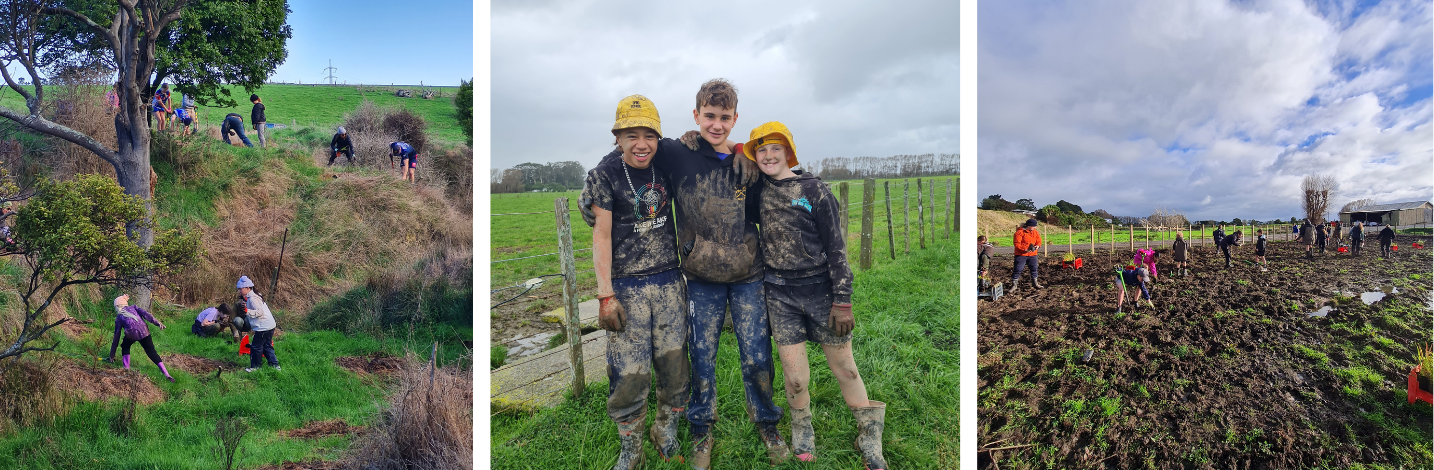
What we've done so far
The first year of the Trees for Survival programme in Manawatū has been a tremendous success, highlighting the power of community connections in conservation and habitat restoration.
We worked alongside a range of valued partners, including Ahimate Reserve Community, Rotary, Horizons Regional Council and Palmerston North City Council, to achieve our planting goals. During the year, we also strengthened our relationship with Awapuni Nursery, which supplies our eco sourced seedlings, and established a bulk potting mix system using the ENM trailer and reusable plastic tubs. This initiative will help avoid the use of thousands of plastic bags in the years ahead.
Across five schools, Palmerston North Intermediate Normal School, Riverdale School, Turitea School, Opiki School and Glen Oroua School, students grew and planted around 4,628 native plants. These seedlings are now establishing in riparian areas throughout the Manawatū River catchment. Planting sites span both sides of the Ruahine Ranges and include private farmland as well as public land at Ahimate Reserve.
Following the programme's expansion into Manawatū and the South Island, the Trees for Survival team has decided to focus on consolidating growth next year, with only two additional schools being added nationwide. Thanks to the outstanding efforts of ENM, our participating schools, Menzshed Manawatū and our dedicated landowners, Manawatū has been selected to welcome one of those schools.
We are excited to bring Awatapu College, our first secondary school, into the programme in 2027 and look forward to continuing to grow the impact of Trees for Survival across our region.
To see more about what Trees For Survival are doing across the country, see their website.
 ENM on Facebook